Home Products Ordering Toptips London Edinburgh Cardiff
   

For more information on all aspects of running check out runningforfun.co.uk, it's impartial and full of practical and sensible advice.

At Run and Become, we are all running enthusiasts. In this page we will share philosophy, tips and information that we have stumbled upon over the years... These are in the form of short articles, by staff members. When you finish the article you could come back to the menu by clicking on "TopTipsTop". You can select from the menu on the left.

When to change your shoes...
You can expect to run approximately 500 miles in a road shoe with a good level of cushioning. After that, the shoe may not protect you adequately from the effects of impact. Shoes with a lower level of cushioning will need replacing more frequently than shoes with a higher level of cushioning. How quickly the cushioning degrades can depend upon your weight and the hardness of the surface on which you are running.

The added stability in shoes for overpronators will also become less effective over time, but should last as long as the cushioning lasts. Racing flats are made to be lightweight and therefore have less cushioning to start with. The Nike Mayfly, for example, weighs only 135 grams and is designed to perform well for 100 kms of fast running (e.g. ten 10k races).

Otherwise, change your shoes when you like the colour of a new model (only joking!).

TopTipsTop

A Garment For All Seasons...
It has been said - "There's no such thing as bad weather, only inadequate clothing."

These days there is a dazzling array of superb technical running apparel to keep you running cool/dry/warm/happy, whatever the weather. So why choose to buy a dedicated piece of technical running wear when you already have a drawer full of old and faded t-shirts that would surely do just as well. Wouldn't they?

Well, actually, no. When you run in a cotton t-shirt, as you warm up the cotton fabric blocks the transpiration of body heat so you just keep getting warmer and warmer. The warmer you are, the more you sweat, but not to worry because all this perspiration or glow (depending on your gender) will be very nicely soaked up by your super-absorbant cotton T, which then becomes damp, heavy and chafe-able. Plus if the temperature drops, as on those long evening runs, your nice wet t-shirt will magnify the wind-chill factor leaving you literally chilled to the core.

What Next?

Enter the modern-day technical T...
A technical T will typically be made of a man-made fibre such as polyester. This has lighter, less absorbant fibres which in themselves will hold onto less moisture than cotton. Unlike those polyester tops of the seventies which some may fondly remember (known as boil-in-the-bag tops), modern polyester tops are made using a special fabric weave which is not only highly breatheable but will also encourage the movement of moisture from the inside to the outside of the garment for rapid evaporation so that you also stay dry even when you're working hard. (This process is called "wicking".) This also means that if you are caught in a rain shower once the rain stops you'll dry out rapidly and avoid that uncomfortable chilly feeling. The best tech t's in fact have a fabric weave that moves moisture to the outside and then spreads it across the surface for extra-rapid evaporation. And it doesn't stop there.

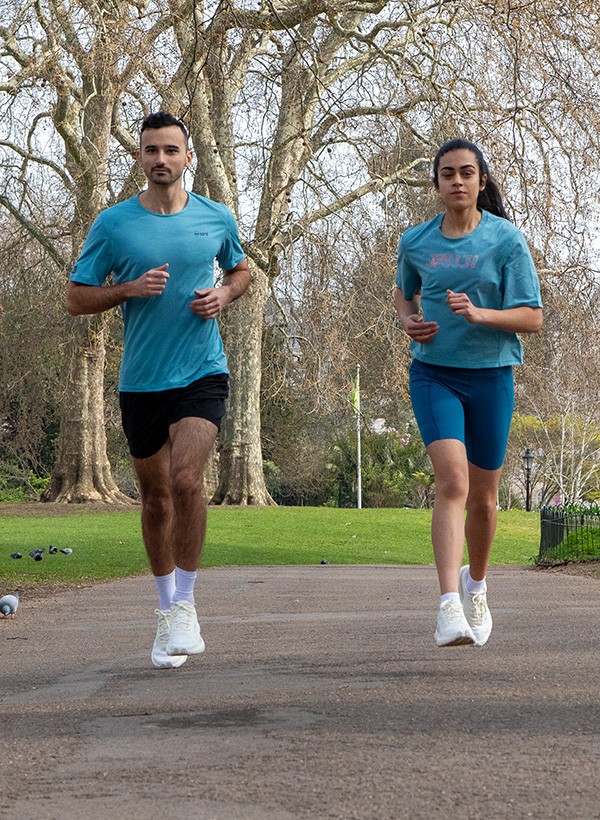
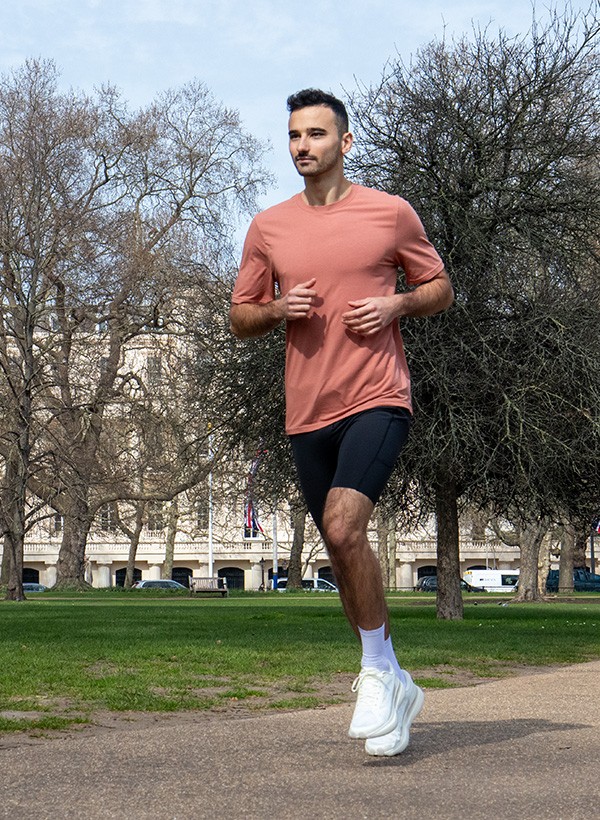
For total running comfort you can clad yourself head-to-toe in technical fabrics, and then layer up for the winter months. A summer running short will typically have a wicking liner with a quick-drying lightweight microfibre outer. Lycra shorts and tights will have stretchability, breatheablity and wickablility. For winter running there are long-sleeves with additional thermal properties so that on a cold day you can enjoy the satisfaction of going out running in a single lightweight layer. And for those only-too-frequent wet days there's a wide range of jackets with various combinations of showerproofability, waterproofability, and again that all important breatheability.

Running's a great sport so you might as well enjoy it. Technical running clothing isn't a total essential (unlike a properly fitted and appropriate shoe) but it does make for much more comfortable running and therefore much more fun whatever the weather.

Happy running!

TopTipsTop

Routine Maintenance
Stretching after a run is an essential investment in further training. Careful stretching lengthens the muscles and keeps them elastic to that they respond more willingly when running. Always warm up first before stretching, as stretching a cold muscle can potentially cause injury rather than helping to prevent it. Yoga is a fantastic support for a runner's body. This full-body non-impact workout is great for rest days, or even as a daily supplement to running. Visiting a qualified practitioner who specialises in prevention and cure of sports injury is also a sound investment, especially when the body is under extra pressure, e.g. during marathon training. Regular visits to a sports massage therapist, shiatsu practitioner, osteopath, or chiropractor can help keep your body balanced and supple, making running safer and easier. Chiropractic treatment is becoming increasingly popular amongst runners in the UK. Visit our London page for practitioners in the London area.

TopTipsTop

Preparing for your first race
Here are some simple tips to prepare you for your first race that may help you avoid making some common mistakes. It is a good idea to follow a training plan or at least gradually increase your distance until you feel happy about training the race distance. Don't get a new pair of running shoes just before your race because it is better to break them in at least a few weeks beforehand. If you want to get some new clothing for the race, wear it or at least wash it beforehand to avoid chafing.

If you want to take an energy gel during the race try it out on a training run beforehand. You usually need to take gels with water, so in a race it is good to take one just before a drink station.

It is good to drink a little at each water station. You might want to practice drinking on your training runs. The amount of fluid you need obviously varies depending on the weather. On a hot day it sometimes helps to pour a cupful of water over your head as well.


Don't worry about having anything special for breakfast before the race, just eat what you usually have before you go out for your run. You might want to practice going for a run at the same time of day as the race, especially if it is at a different time from when you usually run. The most important thing is don't do anything you haven't tried out first on a training run.

Enjoy yourself! Have fun and don't worry about what time you do!

TopTipsTop

Spikes
Choosing The First Pair
When they first start athletics with their local club or school most youngsters and beginners will try out a variety of track and field events and possibly cross-country in the winter.

The best choice for this is an "all round" spike which will give enough cushioning for distance events, but will still allow you to get on your toes and run fast! They can also be used for training and competition and for cross country with longer spikes.

Cross Country
All round spikes can be used for cross-country with longer spikes to give better trip (9mm, 12mm or 15mm depending on the conditions).

There are also specialist cross-country spikes. These have a more rugged one-piece outsole for better grip and a flexible spike plate giving a more secure foot strike on rough ground. They also have a more durable and protective upper.

Some cross-country courses state they are not suitable for spikes and that is when the spikes v studs debate starts. Studs have rubber pyramid-studded soles (eg Walshes), which can be used, on any cross-country course and for hill running.

Competition
Once you are specialising in a particular event you may want to get a specialist competition spike. These generally have more technical features than all round spikes and are designed more specifically for a particular discipline: sprints, middle or long distance on the track, as well as shoes for all the individual field events. These can be used for training as well, but the track spikes will generally not offer as much cushioning or protection as a more specialist spike.

Also generally not for use in cross-countries as the spike plate can be damaged on stony sections of a course.

Runners either prone to injuries or recovering from injury sometimes use racing shoes for training on the track to give more cushioning.

TopTipsTop

Kit Fit For The Fell
This article is aimed at the newcomer to fell running, so I should begin with a note of caution. If you're getting into the sport from a road running background, please be aware of the safety requirements of running in mountain terrain.


Don't go alone, or if you have to, make sure someone knows where you are running and when you expect to return. Plan your route carefully, and have a bad-weather-route lined up should conditions get rough. Even here in Britain, the mountains can and do claim the lives of unprepared walkers and runners - don't let it happen to you. Of course, having the correct kit is also essential for safety and comfort. Lets start with your feet.

Fell Running Shoes
There is an ever-widening choice of footwear for fell running, from the traditional 10mm stud of a Walsh PB to newer Inov-8 models like the Mudroc and Mudclaw. They are all designed to offer excellent traction on steep and/or rough terrain, but differ slightly in fit and feel. Deeper studs are better in very wet or muddy conditions whilst a less aggressive sole will be more comfortable on mixed terrain. Fell shoes are designed primarily for racing so they are very light and will drain quickly when wet. Cushioning is usually minimal to keep the foot close to the ground and reduce unnecessary weight. The Adidas Swoop does have a slightly softer midsole material, and for long distance racing or training the Mudclaw 330 has a more substantial sole. For very rough or rocky ground the Walsh PB extreme is an option, with a narrower fit and a more protective upper. The Mudclaw 270 is designed for racing on steep terrain with good grip on wet rock. Both the Walsh PB and the Inov-8 Mudroc 290 are great all-round options for racing and training.

The single most important factor in deciding which fell shoe to purchase is the fit. They should feel snug but comfortable and hold well at the heel so they don’t come off in the mud! There should be no lateral movement inside the shoe and not too much space at the front. Most people find that it is this, rather than the exact technical specifications of the shoe, that determines which shoe will be best.

See our fell shoe range here.

Other Essentials
If you enter an FRA approved fell race, you'll find that there are mandatory kit requirements, and these give a good guide to the essential kit for fell running in general. Typically, a runner needs to carry windproof or waterproof top and leggings, map, compass, whistle and emergency rations. These are usually stuffed into a waist pack (bum bag) to be whipped out when required.

Waist Packs
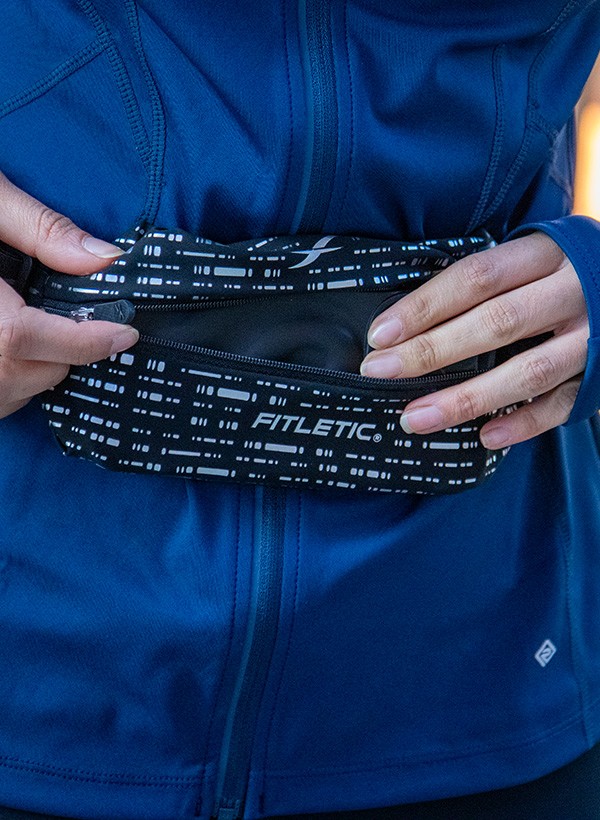
The Pete Bland bum bag is a classic item of fell running kit, just the right size for all your essentials and with compression straps to keep it snug and stable against your back. Some more expensive bags may offer extra compartments so you can divide your kit up, or pouches for water bottles.

See our waistpack range here.

TopTipsTop

Drinks and Supplements
Views on drinks and supplements vary widely according to individual taste and constitution, but here are a few general guidelines, (preceded by a brief science lesson for those who are unsure of the basics).

Carbohydrate
Carbohydrate is the stuff the body finds easiest to convert into energy. We can only store a certain amount of carbohydrate in the muscles (in the form of glycogen). To make this fuel readily available, we can store it up in the muscles prior to running, as well as keeping it topped up during a run. There are many different sources of carbohydrate, but the best for sustained release of energy are called "long-chain". These are mainly found in energy drinks and gels in the form of maltodextrin. Glucose and fructose are "short-chain", providing a more immediate but short-lived effect. Often you will find the main ingredient is maltodextrin, but with smaller amounts of glucose or fructose. This is to provide an immediate short-chain burst, followed by a more sustained long-chain release.

Carboloading
Storing as much carbohydrate in the body before a run (carboloading), means we don't have to try and cram so much in during a run to replenish our starving muscles. Once the stored glycogen is used up, the body will have to resort to burning fat, which is harder work. (If your aim is to burn fat, then of course you might not want to make that glycogen too readily available!). So why not just eat more? Well, for example if we are tapering before a marathon we might not want to stuff ourselves with endless bowls of spaghetti. Too much bulk can make us feel bloated, and may mean we are taking on unnecessary amounts of fat and protein into the bargain. A pure carbohydrate drink (in addition to a healthy diet) is an efficient way of stocking up the muscles with fuel.

Hydration
Hydration affects performance. How much we need to drink when running depends on the temperature, humidity and how hard we are working. It also depends on how well hydrated we are before we start. Dehydration can radically reduce our speed, as well as producing the undesirable side-effects of headaches, nausea and cramps. Electrolytes are valuable minerals, which we can lose through perspiration. The main ones are sodium and potassium. If these levels get too low it's harder for the body to absorb water, and dehydration becomes a downward spiral. An isotonic solution is the same concentration as your body fluid (this will obviously vary slightly according to the individual). A hypotonic solution contains more water. Isotonic is good for getting the carbohydrate into the body as fast as possible, but hypotonic is best for hydration and sustained energy. It's a good idea to use a hypotonic solution of a carbohydrate drink containing a good balance of electrolytes during a run. If you need an energy boost, then it's best to go for something isotonic. Talking of energy boosts, what about gels?

Energy Gels
Gels come in little disposable plastic packets, and are therefore an easy way to carry carbohydrate during a run. With most of them you need to drink water, as they are concentrated. Some are already in isotonic form, and therefore designed to be taken without fluid. They all vary in terms of pack size and shape, as well as their vitamin and mineral content. Isotonic ones are a little bulkier than concentrated ones because of the higher water content.

Energy Bars
Bars are a handy, easily digestible source of energy before a run, and a quick source of energy afterwards. They can be especially useful when fitting a run into a busy routine, or when racing away from home. Most people find them difficult to digest during a run though. Protein bars are best used after a run to aid recovery. What else can we do to speed up recovery?

Recovery
Now we've done the hard work, we need to replace all that carbohydrate we have leeched out of our muscles for fuel, and all that electrolyte fluid we've sweated into our technical T-shirts. If we started out well-hydrated and worked hard to replace as we went along, then this won't be too difficult, but don't underestimate how much you need to drink after a run. It's good to carry on with a hypotonic electrolyte drink even after running. Protein is key for rebuilding muscles. A good recovery drink will have a mix of carbohydrate and protein, plus those vitamins and minerals your body will be crying out for after all the exertion. Most of them can be mixed up and put in the fridge before you go out for a long run. Then it will be nicely blended and chilled, and you can access it as soon as possible after you finish.

What Next?
Most drinks and supplements come in a variety of flavours to suit individual tastes, and most come in trial size packs. It's so important to try things out in training so that you can find out what flavours you like, and how the different types make you feel. There can be nothing worse than trying something out for the first time in a race and finding all your hard training is wasted because a certain flavour or consistency makes you feel sick or bloated. This is one setback which can easily be avoided, so the best advice is cross it off your list of running risks by doing a little research and experimentation to find out what suits you.

TopTipsTop

Moonwalk
Each May, starting at midnight, there is a marathon length walk through London to raise funds and awareness for Breast Cancer.

In the lead up to the walk, we get quite a few customers coming in for shoes and advice and their biggest quandary is always 'Do I use walking shoes or running?'

Well, we don't claim to know anything about walking shoes as we have never stocked them, but we do know that running shoes are very comfortable to walk in. It can be hard to find specialised walking shoes (not trekking boots which are made for rugged terrain and are not suitable for the roads of London) they are made but very few shops stock them, but a running shoe had all the cushioning a walker needs plus its light and flexible. The trick is to chose a shoe that is not too soft. Soft shoes are nice for running, when your momentum is greater, but when walking it can slow you down; spending too much time sinking into the cushioning and then having to up the momentum to get your foot back off the ground. A shoe with firmer cushioning will still give all the protection your feet and legs need but will also be easier to walk in.

Always remember to get the shoes big enough, your feet are likely to swell considerably during the long walk, and if you chose to go for a running shoe make sure its fitted properly not only for size but also support (the same rules apply with pronation/neutral/supination as they do when selecting a shoe for running). You will also want a nice soft pair of socks!

TopTipsTop

Over Pronator/ Over Supinator/ Neutral: what are you?
If your foot pronates then when it hits the ground the arch collapses and the foot rolls inwards. This is quite a common foot strike.

If you are a neutral foot striker then your foot stays upright as you move through the stride. This is less common.

If you supinate then when your foot hits the ground it rolls forwards along the outside edge of the foot, This is rare.

An over - pronator generally needs an 'anti - pronation' shoe with more support on the inside. A neutral runner needs a neutral, well cushioned shoe. There are no shoes specifically designed for a supinated gait but a flexible, curve lasted shoe often works well.

The most accurate way to find out which way your foot moves is to have someone watch you run. This is something we can do for all our customers to help you decide which shoes are right for your particular foot strike.

TopTipsTop


Copyright © 2008 Run and Become. All rights reserved.